Why the Product Owner May Be the Most Important Role in Your Organization
- And Why It Shouldn’t Be the Product Manager

I’ve had this conversation more times than I can count.
With delivery leads, product managers, engineers, or business sponsors, the pattern repeats.
They’ve got a team. They’ve got a backlog. There’s a strategy. Everyone’s busy.
And yet… something’s not flowing.
Delivery is happening, but the outcomes aren’t clear.
The backlog keeps growing, but learning doesn’t.
Feedback comes in, but rarely shifts what’s built next.
Decision-making is either stuck at the top, or spread so wide it disappears.
Somewhere in the system, something is missing.
Often, it’s this:
No one is clearly responsible for the continuous flow of value — into and out of the team.
And that’s where the Product Owner role shows up, not as a gatekeeper, but as the person who holds the space between strategy and execution.
Not Owning the Flow Comes at a Cost
When the Product Owner role is absent, undefined, or misunderstood, a predictable set of symptoms show up:
- Product Managers get dragged into day-to-day ticket clarification
- Developers fill in the blanks and guess at priorities
- Technical needs are deprioritized until they become problems
- Strategic bets are broken into mismatched tasks
- Delivery gets reactive, faster, maybe, but not clearer
It rarely looks like a crisis. It just feels heavier than it should.
The cost isn’t always visible. But it’s there, in missed opportunities, shallow feedback loops, and outcomes that don’t quite match intentions.
What the Product Owner Really Owns
The Product Owner doesn’t own the product strategy.
They don’t own the team.
They own the part most often overlooked… the present-tense value system.
That means they:
- Shape and maintain a backlog that reflects the most current understanding of value
- Make daily prioritization decisions without unnecessary escalation
- Ensure discovery insights and technical realities show up in what gets built
- Balance near-term delivery with long-term outcomes
- Maintain alignment without micromanaging
The Product Owner works in the present, but with a kind of peripheral vision.
They stay close to the team, but attuned to what matters across the customer, business, and tech landscape.
They don’t just decide what to build, they keep the product real.
Why It Shouldn’t Be the Product Manager
It’s common for organizations to assume the Product Manager can hold both roles.
One product, one owner.
But in practice, that thinking creates overload and fragmentation.
Product Managers operate across markets, stakeholders, roadmaps, and long-term vision. They need altitude and time to think, connect, and design.
But when they’re also asked to be present with the team every day, clarifying, deciding, adapting, both roles suffer.
That’s not a performance issue. It’s a structural one.
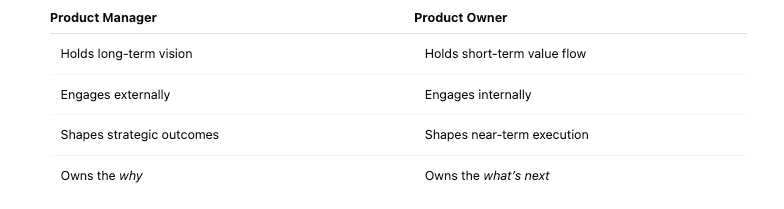
Both roles matter. But if you ask one person to do both, the system becomes reactive, and learning slows down.
When the Product Owner Role Is Supported
Where this role is clearly held and supported, things shift.
- The backlog becomes a signal of clarity, not a list of requests
- Teams move with more confidence and less friction
- Product Managers gain space to lead, not just chase
- Technical and business insights merge earlier
- Feedback loops become actionable, not theoretical
Typical Performance Improvements When PO Role Is Done Right
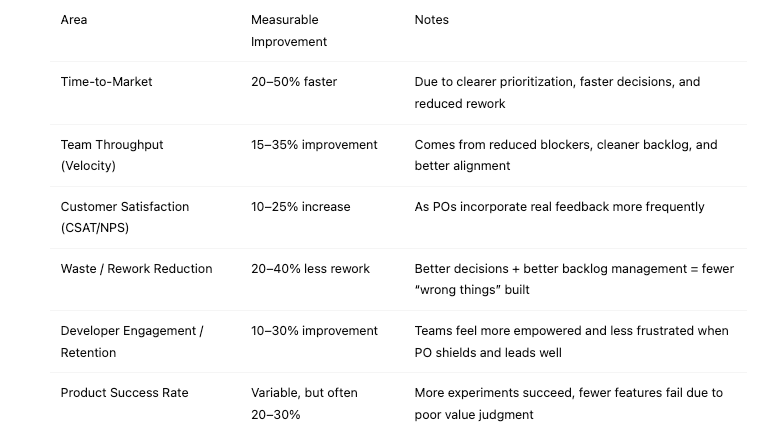
These ranges are consistent with findings from DORA, McKinsey, Atlassian, and internal enterprise Agile transformations.
It wasn’t about working faster. It was about working clearer.
The PO and the Customer
Some worry that a Product Owner who focuses on delivery won’t stay connected to the customer.
But the best POs operate like guides in complex terrain.
While the Product Manager looks toward the horizon, the Product Owner watches the ground ahead, reading the environment, adjusting direction, and guiding the next step.
They do it with peripheral vision, alert to shifting customer needs, organizational constraints, and technical signals, all while focused on what must happen now.
A good PO is not removed from the user, they bring the customer’s voice into the team’s daily decisions.
Not by repeating vision statements, but by shaping stories, clarifying value, and saying no when necessary.
The Product Owner’s proximity to the customer is practical, not performative. And it keeps the team grounded in reality, not assumptions.
It’s Not About Titles. It’s About Responsibility.
I’m not attached to the name.
You don’t have to call it “Product Owner.”
But the role and the function has to exist.
Someone needs to:
- Hold space for decisions that shape delivery
- Integrate real feedback into what happens next
- Balance product intent with technical integrity
- Protect the team’s focus
- Translate ambiguity into action
If no one does this, delivery slows down, not because the team is slow, but because clarity is missing.
The system becomes noisy. Priorities blur. Strategy drifts.
Thoughts
The Product Owner may not be the most visible role.
They’re not always in the customer interview.
They’re not always writing the big vision doc.
They’re not always presenting to leadership.
But they are often the difference between a team that builds momentum, and a team that just builds.
If your product system feels heavier than it should…
If strategy keeps getting lost between planning and delivery…
If decisions take too long, and feedback comes too late…
Start by asking this:
Who owns the now? Who owns the flow?
The article is written also in Norwegian in collaboration with Miles,
https://www.miles.no/post/hvorfor-produkteier-kan-vaere-den-viktigste-rollen-i-din-organisasjon