

Using Perceptual Positions and Embed Shared Understanding in Product Requirements (PRDs)

Too often, teams believe they’re aligned, until delivery tells a different story. The disconnect isn’t always about what’s written down. It’s about how differently people see the same problem. Each role holds a slice of the truth, and if those slices don’t overlap, the product suffers. Teams often hear the words of stakeholders but miss their worldview. This is where the idea of shifting perceptual positions becomes useful, not as abstract theory, but as a practical discipline for exploring the problem space from multiple viewpoints and building shared clarity.
Unfortunately, many teams skip writing a proper PRD altogether, either to move faster or because they believe agile ceremonies or tickets are enough. But skipping the PRD is often a short-term optimization that creates long-term friction. Without it, teams lose the shared lens that aligns design, development, and delivery.
Still, this isn’t about generating more documents. It’s about creating space for deeper conversations. The value isn’t in the artifact, it’s in the act. Building a PRD is an opportunity to slow down just enough to align meaningfully before speeding up.
Eliciting Requirements with Perceptual Agility
To design meaningful products, teams must move beyond just collecting inputs. Requirement elicitation should be seen as a perspective-gathering process, where the team actively shifts between:
- First Position (Self): What do we need to understand, solve, or deliver? (internal role: product, tech, design)
- Second Position (Other): What does the user, customer, or stakeholder experience? (external empathy)
- Third Position (Observer): What patterns, gaps, or contradictions can we see from a neutral vantage point? (systemic clarity)
This movement uncovers not just what is needed, but why, for whom, and under what conditions.
Example:
A stakeholder might say: “It needs to be fast.”
- 1st Position hears: “We need to meet delivery metrics.”
- 2nd Position uncovers: “Users are frustrated by wait times.”
- 3rd Position realizes: “Speed is a symptom. The core issue is trust in responsiveness.”
The PRD as a Converged Perspective
A mature PRD isn’t just a list of features or acceptance criteria. It’s a representation of shared perspective, an artifact shaped by the dialogue between roles, domains, and experiences.
The PRD should not only result from perceptual shifts — it should guide the reader through them.
Structure the PRD to mirror the 3 positions:
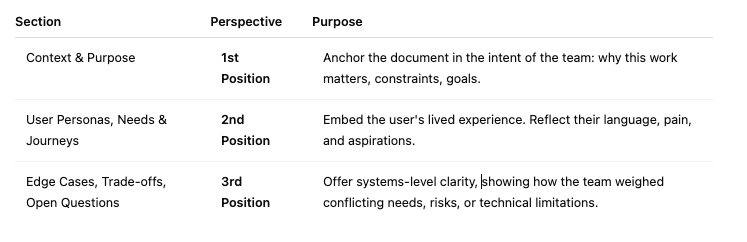
When done well, this structure walks the reader through a layered understanding, helping them align not just on what is being built, but why and for whom.
Why This Matters
Most misalignment isn’t due to bad requirements — it’s due to unintegrated perspectives. By applying perceptual positions both:
- In the process (eliciting requirements), and
- In the product (the PRD structure),
we shift from individual assumptions to collective understanding.
“Understanding is not when everyone agrees. It’s when everyone sees the same landscape, even if they stand in different places.”
Skipping the PRD means skipping this convergence. Teams may still ship, but they risk building disconnected solutions, solving misdiagnosed problems, or triggering unintended consequences.
And here’s the deeper truth: the real value is not the document itself, but the conversations, trade-offs, and shared sense-making that happen while creating it. The PRD is a trace of a deeper alignment process. Without the process, the team risks building in parallel without truly collaborating.
Closing Thought:
A great PRD is not just a document. It’s a rehearsal for alignment. It shows that the team took the time to think together, feel together, and decide together. Teams that move through perceptual positions deliberately build artifacts that speak to everyone, from the sponsor, to the designer, to the developer, to the end user.