

Shifting Perspectives, The Power of Perceptual Positions in Work and Life
Have you ever left a meeting frustrated, feeling unheard? Or found yourself reliving a past conflict, emotionally stuck in the same loop? What if there were a tool that could help you shift perspectives, not just intellectually, but emotionally and neurologically? Welcome to the world of Perceptual Positions, a powerful NLP concept that helps us navigate complexity, build empathy, and make better decisions.
This article explores how consciously shifting between perspectives can transform the way we lead, collaborate, listen, negotiate, and reflect. We’ll also introduce the critical dynamic of being Associated vs. Dissociated, and how this awareness helps us step out of emotional traps and into constructive clarity.
What Are Perceptual Positions?
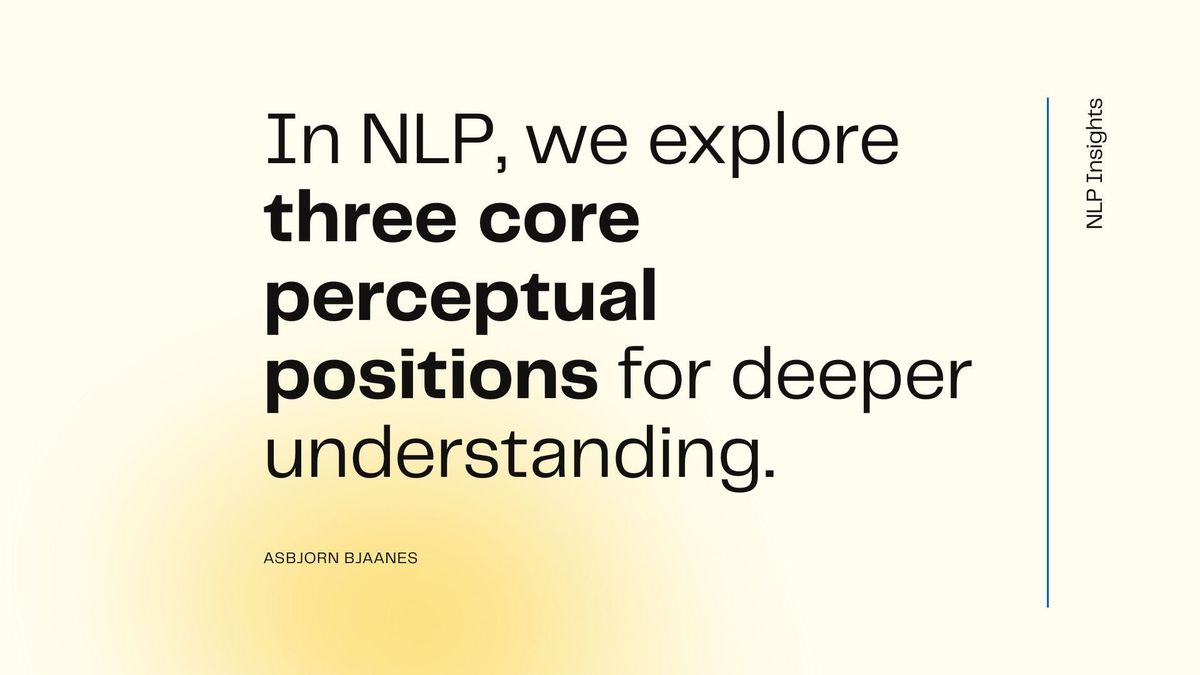
In NLP, there are three core perceptual positions:
- First Position (Self), You experience the world from your own point of view. You are associated into your own body, emotions, and needs. Useful for authenticity, boundaries, and self-awareness.
- Second Position (Other), You step into the shoes of another person. You imagine the world from their perspective, feelings, and values. Builds empathy, listening, and rapport.
- Third Position (Observer), You take a detached view of the interaction, as if watching from the outside. Useful for objectivity, reflection, and systemic insight.
Some also refer to a Fourth Position, a collective or systemic viewpoint. This can be useful in group dynamics or large-scale facilitation.
Associated vs. Dissociated States: How You Experience Events
- Associated means you are in the experience, seeing through your own eyes, feeling emotions directly.
- Dissociated means you are outside of the experience, watching yourself as if in a movie.
Your emotional state often reflects what you are associated to:
- People stuck in negative thinking are often associated to negative events and dissociated from the positive.
- Resilient individuals learn to associate to resourceful states and dissociate from limiting ones.
Consciously shifting these states gives you more choice over your reactions and behaviors.
The Ideal Sequence for Active Listening and Reflection
In emotionally charged situations or coaching, this is a powerful order:
- 2nd Position — Listen and feel what the other person is experiencing.
- 3rd Position — Observe the dynamic with detachment.
- 1st Position — Return to yourself, now with expanded awareness.
This flow ensures empathy (2nd), insight (3rd), and integration (1st). It allows you to respond rather than react.
Where Should We Make Decisions From?
Always return to First Position to make decisions. Only from this space can you:
- Take ownership
- Align with your values
- Act with integrity
But first, visit the 2nd and 3rd positions to gather full data:
- 2nd gives emotional and relational intelligence.
- 3rd gives objectivity and pattern recognition.
This creates decisions that are both wise and grounded.
A common mistake is to move from 1st directly to 3rd and back to 1st, skipping the emotional and relational lens of 2nd position. While this can create the illusion of objectivity, it often results in disconnection, rationalization, or decisions that seem cold or misaligned to others. Without 2nd position, you risk missing the human element entirely. This dynamic can also mirror a confirmation trap, where 1st position assumptions influence what we perceive in 3rd position, and we end up returning to 1st with a decision that feels objective, but simply reinforces our original stance. Skipping 2nd position bypasses emotional data and empathy, which are crucial for relational integrity and ethical clarity.
Using Perceptual Positions in Negotiation and Co-Creation
High-quality negotiation is not about compromise, it’s about co-creating value. Here’s how perceptual positions help:
- Start in 1st — Know what matters to you.
- Move to 2nd — Understand the other party’s motivations.
- Step into 3rd — Observe the dynamic, spot stuck points or win-win opportunities.
- Return to 1st — Make or revise your offer with clarity.
This cycle unlocks collaboration without sacrificing clarity or values.
When We Skip Positions: Common Scenarios and Their Consequences
Minimize image
Edit image
Delete image
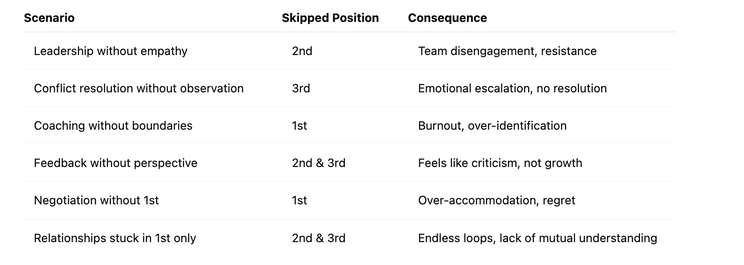
Becoming aware of what you skip is often the fastest path to unlocking new results.
Conclusion: A Practical Superpower
Being able to shift your perceptual position, and knowing whether you are associated or dissociated, is not just a communication trick. It’s a way to become more agile, wise, and intentional in how you relate to yourself and others.
Whether you’re facilitating, leading, coaching, parenting, or simply reflecting, this inner flexibility gives you the power to transform moments of tension into clarity, and disconnection into meaningful connection.
“We don’t need to be stuck in one position. The ability to choose our perspective is what turns insight into impact.”
Now the question becomes: Which position do you tend to skip, and what would change if you didn’t?