

From Features to Transformation: Using NLP’s Well-Formed Outcomes in Product Development
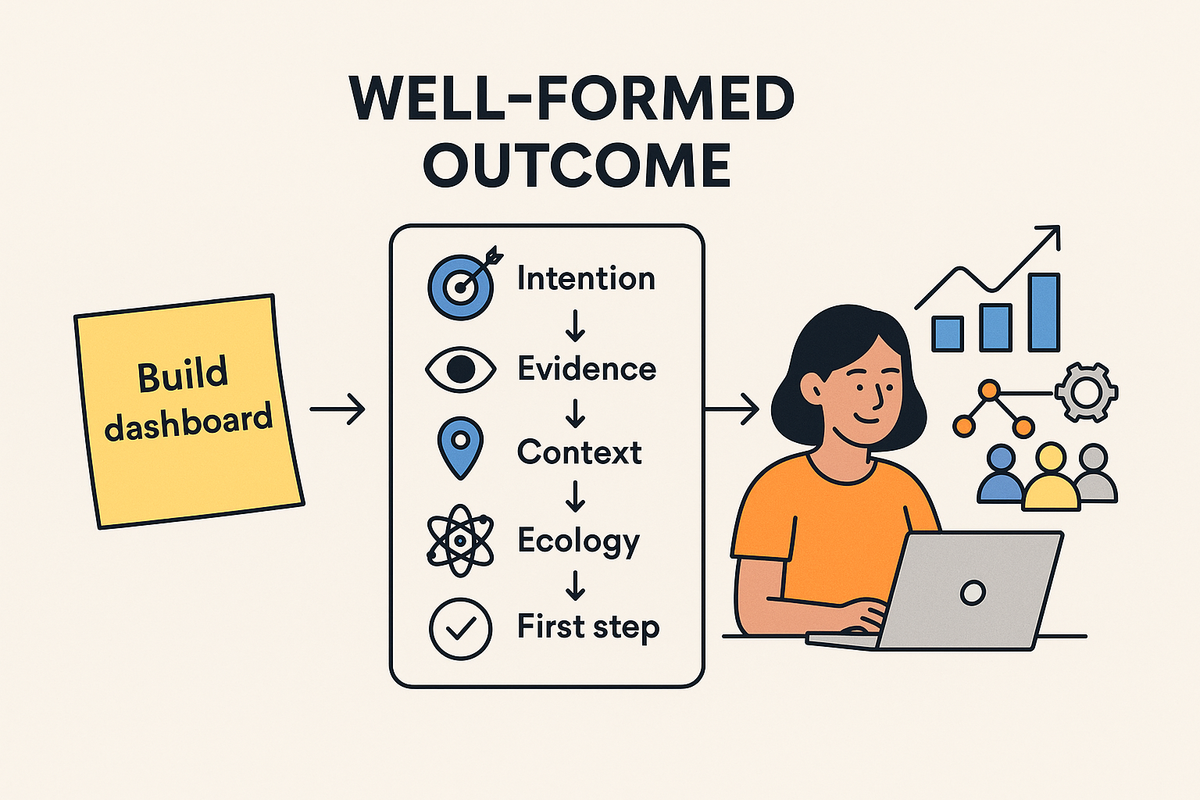
Most product teams focus on what to build. Some focus on why. Very few focus on how the outcome is structured in the mind. Not just in the minds of users, but also in the minds of teams, leaders, and the system around the product.
That’s where NLP’s well-formed outcomes come in. Originally developed as a way to support personal change, this simple framework gives product development something it often lacks: a way to model success before building begins.
In a world of shifting requirements and complex systems, this matters.
What Are Well-Formed Outcomes?
In NLP, a well-formed outcome is a goal that is shaped in a way the unconscious mind can work with. It is specific, embodied, and structured to support clarity and action. Not just a wish or a target, but a shared model of success.
To be well-formed, an outcome must:
- Be stated in positive terms
- Be within your control to initiate and maintain
- Include clear sensory-based evidence
- Be contextualized by time, place, and people
- Be ecologically sound, meaning it works within the broader system
- Allow multiple paths forward
- Include a clear and achievable first step
This is not a formula. It is a structure. And once it is applied to product work, the way teams define value begins to shift.
Why This Matters in Product Work
Many product decisions begin with vague goals. “Improve retention.” “Make onboarding smoother.” “Add dashboards.” As referred to on my other articles, thi is nothing but an idea…
These may feel like direction, however, they lack structure. They tell us nothing about what success looks like, how we would measure it, or how it fits with the larger system.
Well-formed outcomes provide a way to turn these loose intentions into shared clarity. Not through more process, but by changing the way we model intent.
From Feature Thinking to Outcome Modeling
Let’s take a typical backlog item.
“Build an admin dashboard.”
What does that mean? Who is it for? What happens when it works? How do we know if it is successful?
Now let’s apply the well-formed outcome structure.
“Admin users can log in and within 5 seconds view weekly usage data by team and region. This helps them plan resources and prepare reporting. We will know it is working when 70 percent of target users use it weekly, and when qualitative feedback shows increased decision confidence. We aim to ship this to 5 pilot accounts within the next two sprints.”
That outcome includes intention, context, measurement, and a path to action. It gives the team autonomy without ambiguity. It gives stakeholders a language of alignment. And it gives users a product that supports their actual goals.
How to Get to a Well-Formed Outcome
This process is simple, and powerful. It does not require new tools. It requires deeper questions.
Start with the initial request, often framed as a feature or fix. Then begin refining:
- What are we really trying to create here?
- What will users see, hear, or feel when this works well?
- Where and when will this outcome apply?
- Is this something our team can initiate and maintain?
- What impact will this have on other parts of the system, user, business and so on?
- What are some different ways we might achieve this?
- What is one clear step we can take to begin now?
You are not asking for answers. You are building alignment through modeling. You are shaping intent before execution begins.
More Than Clarity, This Is Leverage
Well-formed outcomes reduce the need for rework. They surface assumptions early. They give teams a target that is both meaningful and testable. They create space for creativity, because the what is clear but the how is open.
In agile environments, they support lean, just-in-time clarity. In complex systems, they protect against misalignment. In fast-moving teams, they provide focus without rigidity.
Final Thought: The Architecture Behind Action
Most product conversations focus on what gets built. Well-formed outcomes bring attention to how value is defined. Not in abstract goals, but in lived experience. Not in user stories, but in internal representations of what success feels like.
When product work is grounded in that level of clarity, teams stop chasing features. They begin creating real shifts, in behavior, in understanding, and in outcomes that matter.
Product work is not just delivery. It is designed transformation. Well-formed outcomes give you the structure to make it real.