

Enhancing Product Specifications with NLP Meta Models
Introduction
For Product Managers and Product Owners, the clarity and precision of specifications and requirements can make or break a product’s success. Miscommunications often stem from how we process information — through deletion, distortion, and generalization. Understanding these NLP Meta Models can significantly improve the effectiveness of your specifications, leading to clearer requirements, fewer misunderstandings, and better stakeholder collaboration by ensuring all parties share a common understanding of the preferred outcome, constraints, and implementation details.
The NLP Meta Model: A Framework for Precision
Neuro-Linguistic Programming (NLP) suggests that human perception is not a direct reflection of reality but a filtered version shaped by our internal map of the world. This map is built from personal experiences, beliefs, and cognitive structures, meaning that each individual interprets reality differently. Our brains continuously process vast amounts of information, and to manage this complexity, the mind applies unconscious filtering mechanisms that can lead to deletion, distortions and generalizations.
From a neuroscience perspective, this filtering mechanism primarily involves the reticular activating system (RAS), a network of neurons in the brainstem responsible for prioritizing sensory inputs. The prefrontal cortex, which governs reasoning and decision-making, also plays a role in how we interpret and communicate information. When we unconsciously delete, distort, or generalize information, these neural processes influence our perception and, ultimately, the quality of our specifications and requirements.
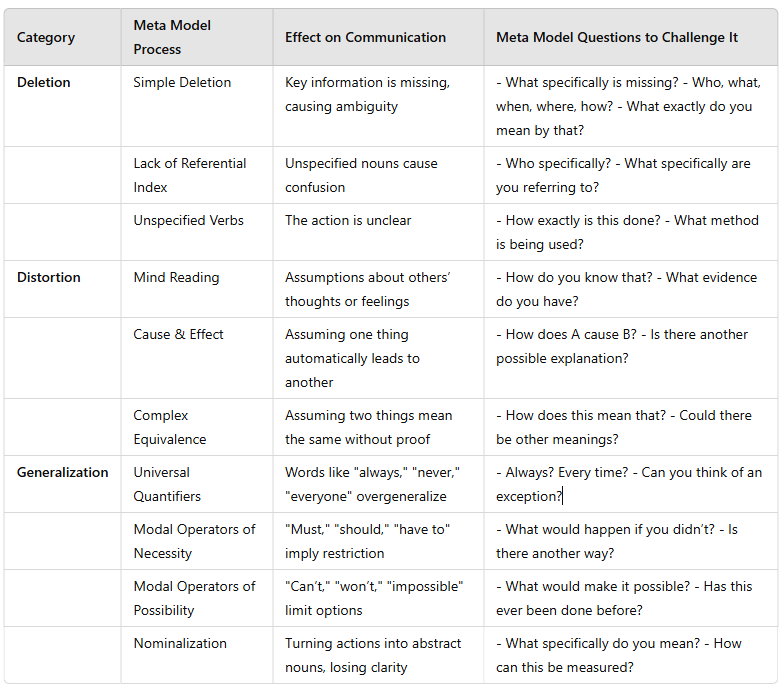
The three core processes of NLP Meta Models are:
Meta Models
Each of these processes can inadvertently reduce the impact of a product specification, leading to gaps, misunderstandings, or misaligned development efforts.
Beyond Clarity: Cognitive and Strategic Impact on Teams
While clarity and shared understanding are often cited as primary benefits of precise specifications, understanding NLP Meta Models extends beyond communication — it is a tool for structuring thought, improving decision-making, and optimizing cognitive efficiency within teams. When specifications are structured to reduce deletion, distortion, and generalization, they enable developers and stakeholders to access more of their cognitive resources while processing the information.
People often interpret clarity in different ways, influenced by their internal map of the world. Some may see it as structured, step-by-step logic, while others rely on broader contextual understanding. Specifications that contain embedded distortions or deletions can lead to gaps in comprehension, regardless of thinking style. By refining language through the NLP Meta Model, specifications become cognitively richer, allowing for deeper engagement, better problem-solving, and enhanced creative thinking.
Instead of just improving communication, well-formed specifications act as a cognitive toolset, enabling individuals and teams to think more critically, adapt faster, and make better decisions., leading to:
- Increased cognitive flexibility — making it easier to see alternative solutions and edge cases.
- Improved working memory load — reducing unnecessary cognitive effort spent decoding vague requirements.
- Greater adaptability to complexity — helping teams manage uncertainty without oversimplification.
Applying NLP Meta Models to Product Specifications
By recognizing how deletion, distortion, and generalization occur in technical and business documentation, product teams can refine their specifications to be more precise and impactful.
1. Addressing Deletion
Problem: A requirement states: “The system should provide user authentication.”
- This omits critical details: What authentication methods? What level of security? What happens on failure?
Solution: Add explicit details:
- “The system must support OAuth 2.0 and biometric authentication. Failed login attempts should trigger a CAPTCHA after three unsuccessful tries.”
Challenging Deletion with Meta Model Questions:
- What kind of authentication is required?
- What happens if authentication fails?
- Who needs authentication and why?
2. Correcting Distortion
Problem: A requirement states: “The app must be user-friendly.”
- “User-friendly” is subjective and open to multiple interpretations.
Solution: Use measurable criteria:
- “The app should have a task completion rate of 95% for first-time users without additional guidance.”
Challenging Distortion with Meta Model Questions:
- How do you define “user-friendly”?
- What specific aspects contribute to ease of use?
- What data supports this assumption?
3. Preventing Generalization
Problem: A specification says: “The system should handle all file uploads efficiently.”
- “All file uploads” could mean anything from small images to large video files, leading to incorrect assumptions about performance.
Solution: Specify scope and limitations:
- “The system should support uploads of JPEG, PNG, and PDF files up to 10MB in size, with processing times under 3 seconds.”
Challenging Generalization with Meta Model Questions:
- Does “all” really mean every possible file type and size?
- Can you think of a situation where this might not hold true?
- What specific constraints should be considered?
Broader Applications of NLP Meta Models in Teams
Beyond improving product specifications, understanding NLP Meta Models can enhance multiple aspects of team performance and collaboration:
- Improved Communication Across Teams — Ensuring that product managers, developers, designers, and stakeholders share the same understanding by reducing misinterpretations in discussions, emails, and documentation.
- More Effective Stakeholder Management — Helping product leaders challenge assumptions, clarify ambiguous requests, and navigate competing interests by identifying and addressing distorted or generalized thinking.
- Enhanced Decision-Making — Providing a structured approach to questioning the underlying logic of decisions, avoiding overgeneralization or missing details that could impact project outcomes.
- Stronger Team Alignment in Agile Workflows — Ensuring that user stories, acceptance criteria, and backlog items are well-formed, reducing friction in sprint planning and daily standups.
- Encouraging a Learning Culture — Teaching teams to recognize and challenge deletions, distortions, and generalizations in their thinking fosters a more adaptive and high-performing organization.
NLP Meta Models: More Than Just a Soft Skill
NLP Meta Models are often mistaken as purely a soft skill, but they go beyond improving conversations. They enable structured thinking, strategic problem-solving, and precise decision-making. By integrating these models, product leaders can create environments where teams engage with information more deeply, avoid miscommunication pitfalls, and develop a culture of clarity and accountability.
Conclusion
Understanding NLP Meta Models allows Product Managers and Product Owners to craft more precise, actionable, and effective specifications. By reducing ambiguity, preventing misinterpretation, and ensuring a shared understanding among stakeholders, teams can minimize development rework, avoid misalignment in implementation, and ultimately deliver products that meet user needs more effectively.
Additionally, by enhancing how information is structured, developers and stakeholders can access greater cognitive capacity, leading to deeper understanding, more creative problem-solving, and better decision-making.
When writing your next specification, ask: Have I removed deletion, distortion, and generalization? The answer could determine your product’s success.