

Emotionally Encoded Communication and the Psychology of Team Ownership

In team dynamics, communication is everything. But not in the way most leaders think.
We often treat communication as the transfer of information, tasks, updates, instructions.
In reality, every interaction we have with our team does more than inform.
It forms a memory, and that memory is charged with emotion.
Emotion Is Embedded in Communication
When someone receives a message, whether in a 1:1, a meeting, or a message thread, their brain doesn’t just capture the words. It stores:
- What they saw (your expression, gestures)
- What they heard (your tone, rhythm)
- What they felt (safe, challenged, disrespected, trusted)
In NLP terms:
- VAK (Visual, Auditory, Kinesthetic) = form
- Emotion = charge (valence + intensity)
Together, they form a neural imprint. That imprint determines how the communication is remembered, and more importantly, how it is acted upon.
Why this matters:
The emotional charge shapes whether the message is stored as a resource (empowering), or a threat (restrictive).
In teams, this directly impacts one critical behavior: ownership.
Ownership or Escape? What the Brain Decides
Every time a team member receives a message, they’re unconsciously asking:
- “Is this safe?”
- “Is this mine to act on?”
- “Will I be blamed if this goes wrong?”
And the answers they derive aren’t logical, they’re emotional.
If the emotional encoding feels:
- Empowering → “I’ve got this.” → Ownership
- Threatening → “I’ll play it safe.” → Escape / Avoidance
- Ambiguous → “Not sure what’s expected.” → Inaction or silence
Example:
Scenario A:
“I’m giving you this because I know you can handle it. Let’s check in next week.”
Tone: warm.
Posture: open.
Emotion: trust.
🟢 Result: Ownership.
Scenario B:
“This can’t go wrong. I’m counting on you.”
Tone: clipped.
Face: stern.
Emotion: pressure.
🔴 Result: Avoidance or perfectionism, not true ownership.
How to Influence Ownership Through Emotionally Intelligent Communication
Here are four practical ways to apply this:
Lead with emotional safety
- Use grounded tone and body language
- Avoid ambiguous messages or pressure cues
Make ownership feel like contribution, not risk
- Frame responsibility as “How might you like to lead this?”
- Invite rather than impose
Communicate with awareness
- Your volume, pace, posture, even where you look, all matter
- Speak slowly and calmly when introducing complex responsibilities
Reinforce agency, not compliance
- Offer choices, even in constraints
- “Here are two ways we can approach this, what do you think?”
3-Step Framework: Notice → Reframe → Reinforce
Notice — Become aware of the emotional signal you’re sending.
- Ask yourself: “If I were on the receiving end, would this feel like trust or like pressure?”
- Listen for clues: tone of voice, body language, speed, timing.
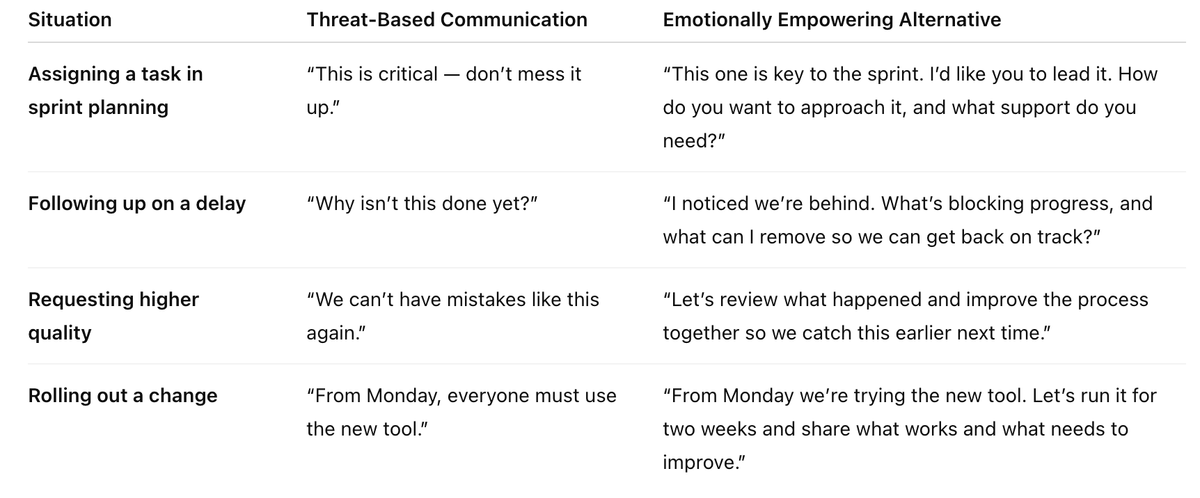
Reframe — Turn the message from a demand into an invitation to own.
- Shift focus: from “you must deliver” → “you have an opportunity to lead”.
- Offer autonomy: let them co-create how to do it. Ownership grows when people shape their own approach.
Reinforce — Follow up in a way that strengthens safety and confidence.
- Acknowledge progress and highlight learning, even if results aren’t perfect.
- Close the loop: ask how they felt about the process and what would make them take even more ownership next time.
Examples of reframing
Final Thought
Ownership isn’t given, it’s elicited.
And the way you communicate emotionally determines whether your team leans in, or leans away.
If your team avoids responsibility, start by examining not their motivation, but their emotional memory of how ownership was handed to them.
Was it empowering, or was it charged with threat, ambiguity, or pressure?
Because in the end:
We don’t remember facts. We remember we are made feeling.
And what we feel becomes what we act on.