

Build Organizations to Behave Strategically

What If Your Teams Acted Like Owners, Without Needing More Structure, Approval, or Control?
Imagine a future-state organization where:
- Teams make decisions at the edge , confidently and fast
- Strategy execution is measured in weeks, not quarters
- Accountability spreads through ownership, not oversight
This isn’t a fantasy , it’s what happens when identity aligns with intent. Not through culture decks. Not through org charts. But through deliberate coaching that makes permission the default.
And it’s not just possible, it’s proven:
- A global tech firm reduced escalation volume by 60% within a quarter
- A product org doubled release throughput after surfacing one hidden belief
- A platform team eliminated 40% of internal dependencies just by shifting how they saw their role
Now, back to why your strategy might still be stuck.
You Can’t Execute a Strategy Your Identity Rejects
When identity aligns with strategy, execution accelerates naturally. Teams decide faster, escalate less, and own outcomes without being told. You get speed, resilience, and accountability, without micromanagement.
Most organizations don’t lack direction. They lack permission. People know what to do, they just don’t believe they’re allowed to do it. That’s not a knowledge gap. It’s an identity one.
A senior leadership team rolled out a bold new strategy to increase delivery speed and decision autonomy. The structure was updated. Roles clarified. Communication crisp. But middle management kept escalating. Delivery still lagged. Coaching revealed a deep-rooted belief across the org: “We still need approval to act.” Structure had changed, identity hadn’t. Once leaders worked through that internal constraint, behavior changed fast. Same team, same tools, new results.
Decisions bounce. Delivery drags. People hesitate.
Not because they don’t understand the strategy, but because the organization hasn’t become what the strategy needs.
You don’t have a strategy problem. You have an identity problem.
This is the silent blocker for execution in companies operating at the edge of complexity, where smart strategy and modern systems still struggle to produce flow.
Until identity shifts, nothing accelerates. And that shift doesn’t come from structure, incentives, or communication. It comes from coaching, used as a strategic asset, not a support function.
Why most organizations mistake intention for identity, and pay the price in execution
Many leadership teams believe they have a strong organizational identity.
And they do, in intention.
They’ll say:
- “We take ownership.”
- “We trust teams.”
- “We’re adaptable.”
- “We empower decisions at the edge.”
But when you watch the behavior?
- Decisions escalate by default
- Teams seek permission before acting
- Ownership is diluted across roles
- Speed is sacrificed for alignment theater
This is the gap:
Most orgs confuse their stated values with their lived identity.
They think because they’ve named a principle, it exists.
But identity doesn’t live in what we say, it lives in what people believe they’re allowed to do.
And when strategy requires a behavior the identity won’t permit?
The system quietly shuts it down.
What you see when identity is out of sync
You’ve seen this before:
- Engineering teams wait to be told
- Product teams hesitate to commit
- Middle managers escalate everything
- Leadership keeps reworking org charts
There are OKRs. Budgets. Clear direction.
But behavior doesn’t shift.
That’s not a capabilities gap.
It’s not even a mindset problem.
It’s a misaligned identity system.
The org is still showing up as the previous version of itself, while asking for next-level results.
This is especially true in organizations operating with high complexity and interdependencies, where global teams, strong product thinking, and engineering excellence meet systems that have legacy identity baked in. Coaching is the bridge that upgrades not just what they do, but who they believe they are.
Coaching is what makes strategy real
Most transformation programs focus on direction and structure.
But execution lives in people’s nervous systems.
That’s where coaching comes in:
- Training add knowledge
- Tools add efficiency
- System add coordination
- Coaching change how people and teams see themselves
You can’t “incentivize” someone into ownership, curiosity, or courage.
You have to build internal permission.
That’s what real coaching delivers, at scale, across roles, across beliefs.
Coaching is not an HR program.
It’s a core transformation system and a strategic lever.
And it produces results. Not soft signals, hard ROI.
According to the International Coaching Federation’s Global Coaching Client Study conducted by PwC, 86% of companies report at least a full return on their coaching investment, and many see returns up to 5–7x. Separate research by MetrixGlobal on Fortune 500 companies found coaching produced a 788% ROI through improved productivity, quality, and organizational strength.
Coaching isn’t just good practice. It’s a proven lever for performance and profitability.
Organizations that embed identity-level coaching report:
- Faster and more confident decision-making at the edge
- Less escalation and friction across functions
- Shorter cycle times and increased delivery velocity
- Higher retention among key roles (due to increased ownership and psychological safety)
Because when identity shifts, people act. Not eventually, but immediately.
Behavior doesn’t follow plans. It follows identity.
If teams believe:
- “We’re here to implement, not decide”
- “Leadership wants control”
- “Mistakes are punished”
- “Success = escalation”
No amount of planning or structuring will change performance.
But if coaching helps teams internalize:
- “We own outcomes”
- “We make the call at the edge”
- “We’re safe to adapt”
- “We don’t escalate by default, we lead”
The change happens. Fast. Sustainably. Across the org.
Capability = Behavior over time. Behavior = Identity in motion
We often confuse systems maturity with readiness.
But systems are not strategy.
And strategy is not execution.
Strategy is only as real as the behaviors it unlocks.
And those behaviors only emerge when people see themselves differently.
That’s what coaching enables, behavior change that sticks, because it’s identity-led, not compliance-driven.
Without coaching, transformation is hopeware
Leadership often says:
“We’ve communicated the strategy. People just need to execute.”
But communication ≠ transformation.
Understanding ≠ belief.
Alignment ≠ embodiment.
You don’t get strategic execution from information.
You get it from identity shifts, and those happen through coaching conversations, not announcements.
Coaching is the structured, evidence-based pathway for enabling this shift, in beliefs, in behavior, and in results.
What identity-centered coaching unlocks
When coaching is built into transformation, here’s what changes:
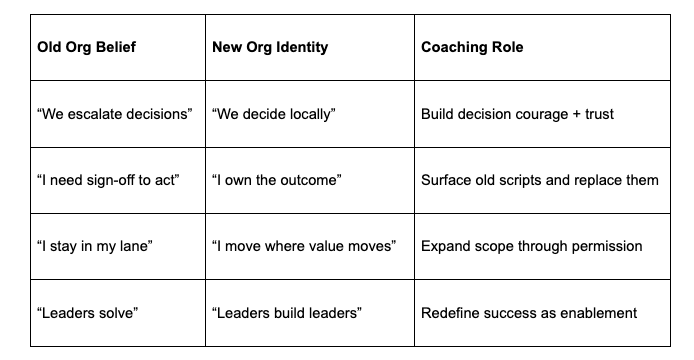
This is where coaching earns its ROI, by re-authoring how people participate in the system.
Coaching isn’t cost. It’s leverage.
The ROI of real coaching isn’t morale.
It’s execution velocity, quality decisions, and ownership at the edge.
It’s the difference between:
- Acting with clarity vs. waiting for alignment
- Owning the result vs. escalating the risk
- Transforming fast vs. recycling old behaviors
In companies leading complex digital initiatives, the tipping point isn’t just process or structure.
It’s who people believe they are when it’s time to act.
You can restructure ten times. Redesign workflows. Add new tools.
But until identity shifts, behavior stays stuck.
Coaching is how identity changes.
And identity is what makes strategy stick.
The provocation
Before you fund another layer of tooling or launch another alignment sprint, ask:
“Where in this system are we still showing up as the old version of ourselves?”
“Who do we need to become, and how are we helping people cross that gap?”
If you can’t answer that, you don’t have a strategy.
You have a wish.
And without coaching, that wish stays on a slide.